


THE ART OF STAYING: William Mellon, manna & the Making of Wilmington
Sixteen years after opening its doors—celebrating the milestone on 3 November—William Mellon's downtown Wilmington restaurant remains one of the city's constants. Helmed in the kitchen by Carson Jewell, it continues to serve thoughtful, beautiful food without chasing trends or shouting for attention. While louder restaurants come and go, manna has mastered something far rarer: staying power.
Story by Colleen Thompson
It's been here for as long as I’ve been coming to Wilmington. Which, in restaurant years, says everything. I want to eat here again before I sit down with Mellon to talk. It feels important. It’s a Friday night, and the city is alive beyond the glass as we look out onto Princess Street. My friend and I take a table for two by the window. Inside, manna inhabits a kind of old-fashioned comfort—the good kind. Wooden tables. Folded white napkins. A small black lamp throwing a gentle pool of light. It feels faintly French, softened by Southern ease. Nothing stiff, nothing forced. Just a room that understands precisely what it is.
And then, almost on cue, the first plate arrives: bread, still warm, torn rather than cut. Knead to Know: focaccia with ricotta and raspberry jam. It feels like a quiet introduction, almost a promise. Manna—food as sustenance, something given rather than performed—translated here into something simple and immediate. It sets the mood for everything that follows: generous, unshowy, quietly confident. Kind of like Mr. Mellon.
The menu reads the same way. French technique, Southern ingredients, a touch of wit. You see it immediately in the names: Wholly Mackerel. Run Forage Run—mushrooms, blue chèvre crème, herbs, toast. Lipstick on a Pig—hickory-smoked Eastern North Carolina pork chop, creamed freekeh, braised greens, chow chow, jus. It’s clever without trying too hard. I want to order everything. I start with oysters, dressed with apple mignonette and a sharp, almost floral note of pickled fennel sorbet. Then, for Pete’s Steak: cast-iron-seared beef tenderloin, mashed potatoes, broccoli, mushroom gravy. It is, quite possibly, the best meal I’ve eaten in Wilmington. Later, Mellon will tell me the beef came from Brasstown Beef, raised by Steve Whitmire. It makes sense. That kind of detail sits quietly behind the plate—part of the story, whether you know it or not.
The following morning, we sit around a dining room table at the restaurant, drinking tea. And this is where I notice something about Mellon. He has a way of speaking that makes you believe everything he says. Not because he is trying to convince you. Quite the opposite. There is very little polish to his answers, and no sense that he is delivering a carefully rehearsed version of himself. He tells the story as he remembers it, with an easy conviction that makes even the least probable details sound entirely possible.
He is a storyteller, though I’m not sure he would describe himself that way.
Where did the love of food come from?
“I’m not sure, but probably a combination of things,” says Mellon. “When I was a kid, we didn’t go out to eat that often. We really couldn’t afford to. But now and then we’d go to this small Italian family restaurant, out in the middle of nowhere, and have what felt like a ‘fancy’ meal to me.” Later came the Army. Travel, if not yet good food, but something started to stir. “When I was in the Army, I was able to travel a bit. I still wasn’t eating well at that time, but it sparked an interest. It wasn’t until after my service and moving to Raleigh that restaurants started making an impact. I started working in restaurants and began blowing all my money eating out.” Then followed the deliberate journeys. “I began saving up to travel to places like New York, San Francisco, New Orleans, Chicago—just to eat at the places I had been reading about in Wine Spectator and Food & Wine.” He smiles slightly. “I still have that travel bug. I think I base where we visit on where we’re going to eat.”
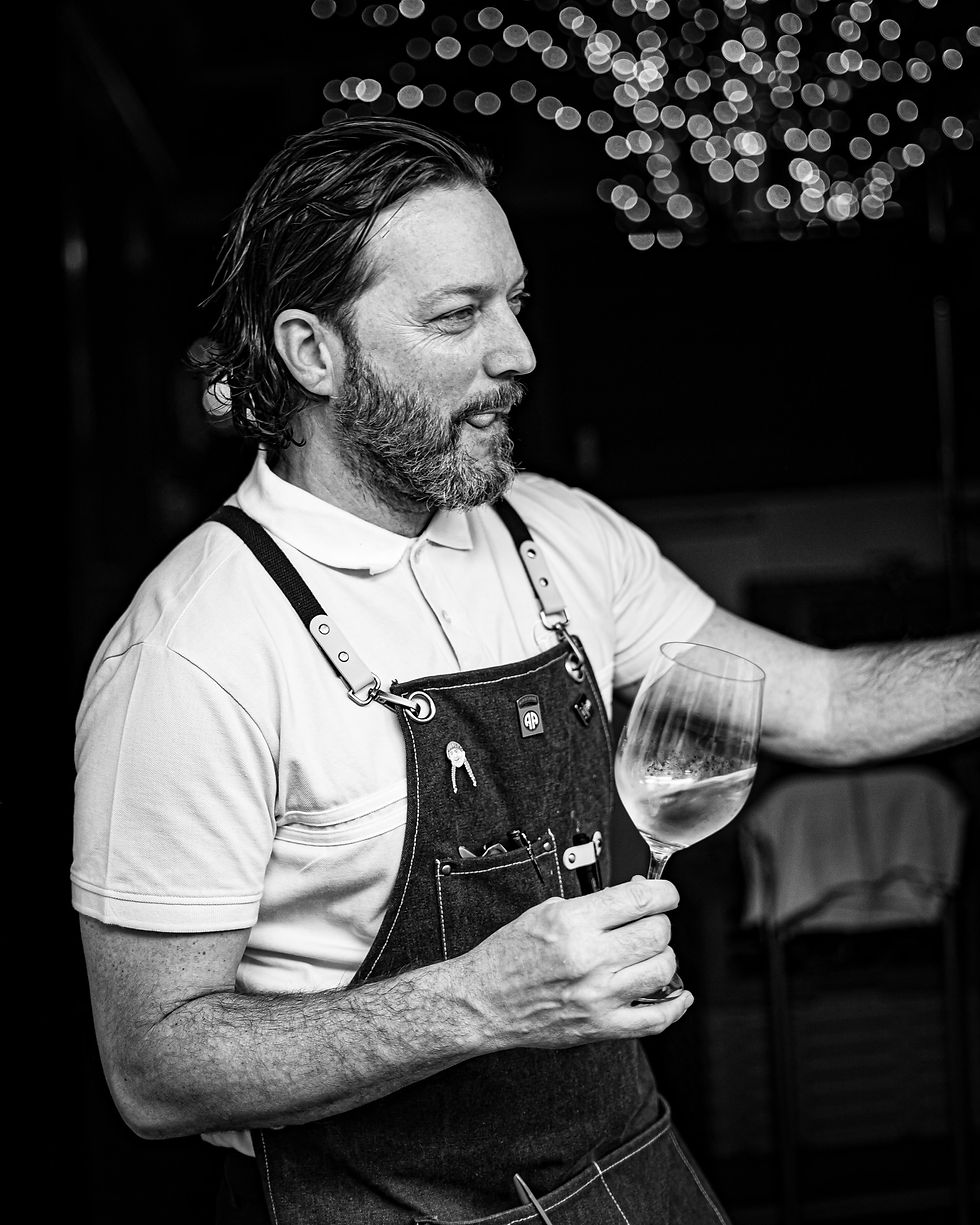
It is an entirely Mellon answer: practical, somewhat mischievous, and delivered with such certainty that you find yourself nodding along. Another detail about him stays with me: the khaki apron he wears, pinned with small emblems that read like a quiet autobiography. “Many of the staff wear pins from local liquor reps,” he says, “but mine are a little more personal.” He gestures to them, one by one. There is his 82nd Airborne pin, a reminder of his military service. A Czech Republic flag; a Sioux Indian chief pin that connects him to his heritage. A Wounded Warrior patch, symbolizing what some of America’s heroes have lost. And a Four Diamond pin, an accolade manna received. “That one reminds me to keep our eyes on the prize.” He pauses, then shrugs, almost dismissing the sentiment. “They’re just pieces of my story, I guess.”
Of course they are.
And that, perhaps, is what makes Mellon so compelling. He doesn’t seem particularly interested in telling you that his life has been remarkable. He tells you what happened, one detail after another, and somehow the significance emerges on its own. By the time manna opened, Wilmington’s dining scene was considerably smaller than it is today. Mellon has had a front-row seat as the city changed around him.
“Initially, we wanted to be a part of the scene and a reason that others came into it. That was always one of my driving points.”
He remembers a time when people would tell him Wilmington didn’t have enough restaurants to constitute a real dining scene. “I would always say, you need more than three or four restaurants in a community to have a real ‘scene.’ Sure, people will drive to obscure cities to eat at a particular place—a barbecue joint, a great family-owned restaurant—but people don’t move there.”
His thinking went beyond restaurants.
“For people to want to uproot and change zip codes physically, one of the things that needs to be there is industry. Well, we have several banks, UNCW, big corporations and the hospital. That gets you professionals. As they expand, they need new employees.”
Then come the neighborhoods. The development. The real estate.
“And all of those people want to go out to eat. They need places to celebrate and have special dinners. Throw in the ocean and the river and ‘BINGO,’ you have a place.”
“It was bound to happen. It just took a while before the restaurateurs from other markets found out about it, ‘saw that the water was okay to swim in,’ and made their way to the coast.” It sounds almost inevitable when Mellon tells it.
Perhaps that is his gift. He has a way of taking a complicated idea, stripping away the noise and explaining it so simply that, for a moment, you wonder why you hadn’t seen it that way yourself. manna, in that landscape, became one of those pieces.
“I think manna has been one of the pieces of the puzzle,” he says. “A place people could rely on for a consistently good experience.” As more restaurateurs arrived, the city’s appetite expanded with them. “Once other restaurateurs came into town and saw that people here were willing to explore different cuisines, to push their palates a bit—that’s when things really started to grow.”
He pauses. “That collective of restaurants, coupled with a few of the old guard, has maybe turned Wilmington into a destination place.” Maybe. He says it casually, but you believe him. There are other pieces of Mellon’s Wilmington, too. Earnest Money & Sons—“e$”—is perhaps the most personal. A small private members bar just down the street from manna, intentionally intimate. “It’s a place I always wanted to create,” he says. “Somewhere small, where people could have real conversations. Step away from the busyness of downtown. Feel…grown up.” It is also, quietly, about his father. “My dad was a big outdoorsman. He loved to fish and hunt. But his first love was horses—he was a jockey and trainer in the 1960s.” The walls of e$ hold fragments of that life. One story, in particular, lingers. “He won a Grade I stakes race in 1963,” Mellon says. “He upset the favorite, Cicada, ridden by one of his best friends—Willie Shoemaker—who was one of the most influential jockeys ever.” The story gets better. “It’s still the biggest upset, odds-wise, in a Grade I race.” Mellon talks about the bar, his father’s photographs, the stories he inherited.
“It’s a little fancier than his tastes, but I think he would have loved to see his photos on the wall and tell those stories, as well as many others. He was an excellent storyteller.”
Something is revealing in that. Perhaps e$ is Mellon’s attempt to create the kind of place where stories have room to breathe. “We wanted a place that was cozy and wasn’t only driven by volume—both in regard to numbers and sound. So many places are about the bottom line. Of course we want to make money, but that’s not what’s important at e$. It’s another experience opportunity.” There are magazine covers on the walls, too. And something quieter. “There’s a photo of my son when he was just a few months old, beside his baby shoes. That one stops me every time I see it.”
Beyond manna and e$, there is Bourgie Nights, the music venue, and Greenfield Lake Yacht Club, a neighborhood bar Mellon opened with longtime collaborator Fred Flynn. When the government widened the road, the club’s building was razed in April 2026. Rather than close, Yacht Club—its new name—found a new home next door to Bourgie Nights, where it now serves as the venue’s bar. It’s a different chapter, with its own pros and cons, but at least the story continues.
There are more ideas, too, though Mellon keeps those close. “Still simmering several pots on the stove.” And then there is the community. “I love it here. That’s why I’ve stayed so long.”
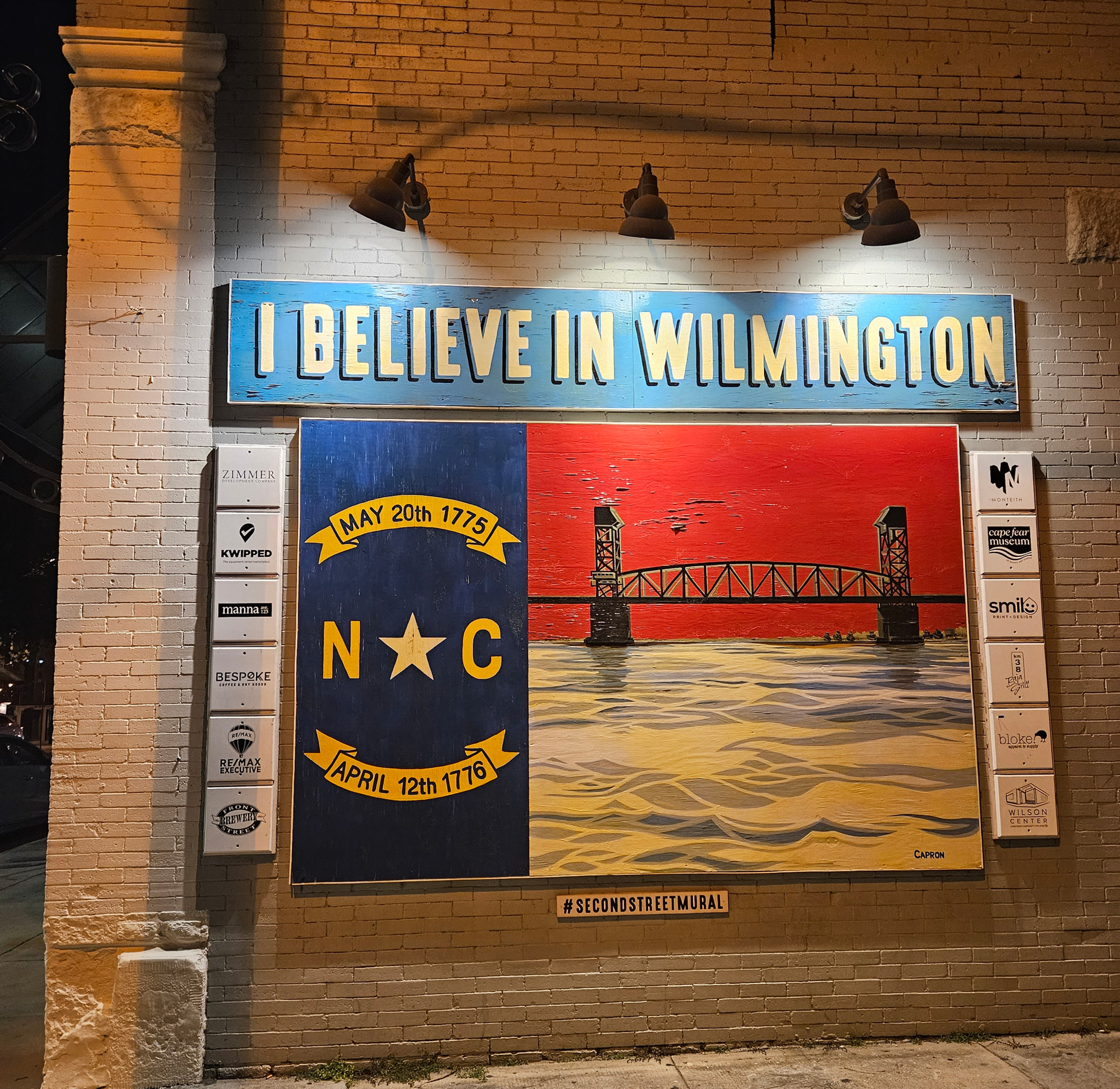
Through 40EATS, a collective of restaurant peers, Mellon has helped raise money for organizations including Nourish NC and Cape Fear River Watch, as well as farmers impacted by Hurricane Florence. His “I Believe in Wilmington” mural has now generated more than $12,500 for local charities focused on children.
“Coming from nothing and now being able to help—it means a great deal to me.” Perhaps that is the simplest explanation for why Mellon’s restaurants feel different. There is ambition and business, certainly, and a desire to build something lasting. But beneath it is something more personal: a belief that restaurants can be part of a place’s larger story.
Back at manna, that story continues. Plates arrive, considered but unfussy. Nothing overworked. Nothing performative. The room murmurs quietly around us. Outside, Wilmington moves. Inside, manna remains—steady, warm, quietly confident.
And Mellon, in his khaki apron, continues telling the story in that unassuming way of his, making you believe every word.


Comments